
The Maxilla: Why Your Upper Jaw is the Key to Facial Health
When most people think of their « jaw, » they picture the bottom part that moves when they chew. However, the upper jaw—known as the maxilla—plays a far more critical role in your health, breathing, and facial appearance than you might realize.
At My Alberta Osteo, serving clients in both Calgary and Canmore, we view the maxilla as the « keystone » of the face. Because it sits right in the center of your skull, ensuring this bone is balanced is essential for everything from a straight smile to clear sinuses and healthy breathing.
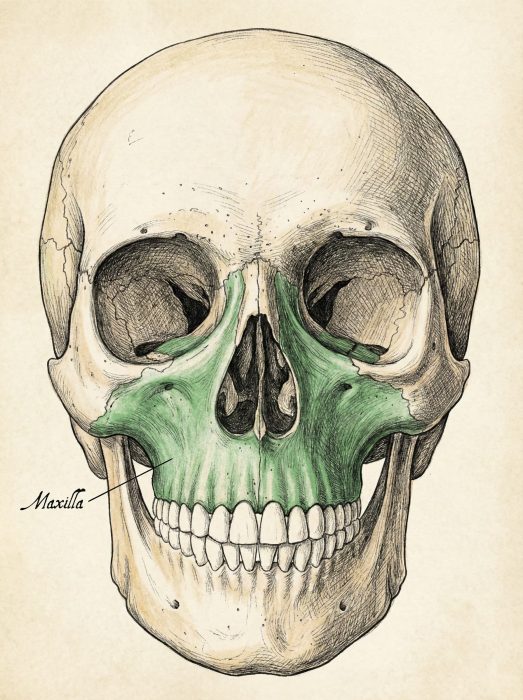
What is the Maxilla?
The maxilla is effectively your « face bone. » It forms your upper jaw, the roof of your mouth (palate), and the floor of your eye sockets. It also houses your maxillary sinuses (the large pockets in your cheeks).
In osteopathy, we pay close attention to the maxilla because it acts as an anchor. It connects directly to nine other bones, bridging the gap between your cranium (where the brain sits) and your face. If the maxilla is tight or misaligned, that tension ripples outward, affecting your eyes, your nose, and even the base of your skull.
The Importance of Growing « Forward and Wide »
The shape of your face is largely determined by how you breathe and where your tongue rests.
Ideally: You breathe through your nose, and your tongue rests gently against the roof of your mouth (the maxilla).
The Result: Your tongue acts like a natural scaffold. Over time, it gently pushes the maxilla to grow upward, outward, and forward.
When this happens, you get a spacious nasal cavity for easy breathing, a wide palate with plenty of room for teeth, and strong cheekbones that support the eyes (preventing that « tired » under-eye look).
What Happens When Growth is Suboptimal?
If someone habitually breathes through their mouth, their tongue drops down. Without that internal support, the maxilla doesn’t grow forward—it tends to become narrow and recessed. This can lead to:
Dental Crowding: A narrow jaw means there simply isn’t enough physical space for adult teeth to come in straight.
Restricted Airway: A narrow upper jaw can trap the lower jaw in a backward position, reducing the airway space in your throat.
Sinus & Allergy Issues: If the facial bones are compressed, the sinuses can’t drain properly. This leads to chronic congestion, which is often mistaken for permanent allergies.
Why Osteopathic Treatment is Crucial
Because the maxilla affects eating, breathing, and speaking, keeping it mobile is vital. Here is how we help different clients at our Calgary and Canmore clinics:
1. For Children (Prevention)
Treating the maxilla young is ideal because the bones are still soft and adaptable. Osteopathy helps guide the bones into that « forward and wide » pattern, potentially preventing severe crowding or airway issues before they become permanent.
2. For Orthodontics and Dental Implants
If you or your child are using braces, expanders, or getting implants, osteopathy is the perfect partner. While orthodontics moves the teeth, osteopathy releases tension in the sutures (the joints between the bones). This helps the face adapt to the changes, making the treatment more comfortable and the results more stable.
3. For Trauma and Sports Injuries
A fall on the chin, an impact to the nose, or even an old sports injury can « lock » the facial bones. You don’t need a fracture to feel the effects—rigidity in the maxilla can cause headaches and pressure. We use gentle manipulation to free these restrictions and restore natural movement.
4. For Sinus Relief
Chronic congestion often comes from « stagnation. » If the facial bones aren’t moving with their natural, subtle rhythm (craniosacral movement), fluid gets trapped in the sinuses. While we always suggest checking for food sensitivities, osteopathy mechanically opens the drainage pathways to help you breathe freely again.
Conclusion
Whether you are a parent looking to prevent future crowding for your child, an adult navigating orthodontic treatment, or someone seeking relief from chronic sinus pressure, the answer often lies in the maxilla.
By ensuring this « keystone » bone is free to move, we support not just a beautiful smile, but a lifetime of optimal health.
Book an appointment in Calgary or Canmore